



Latest Posts


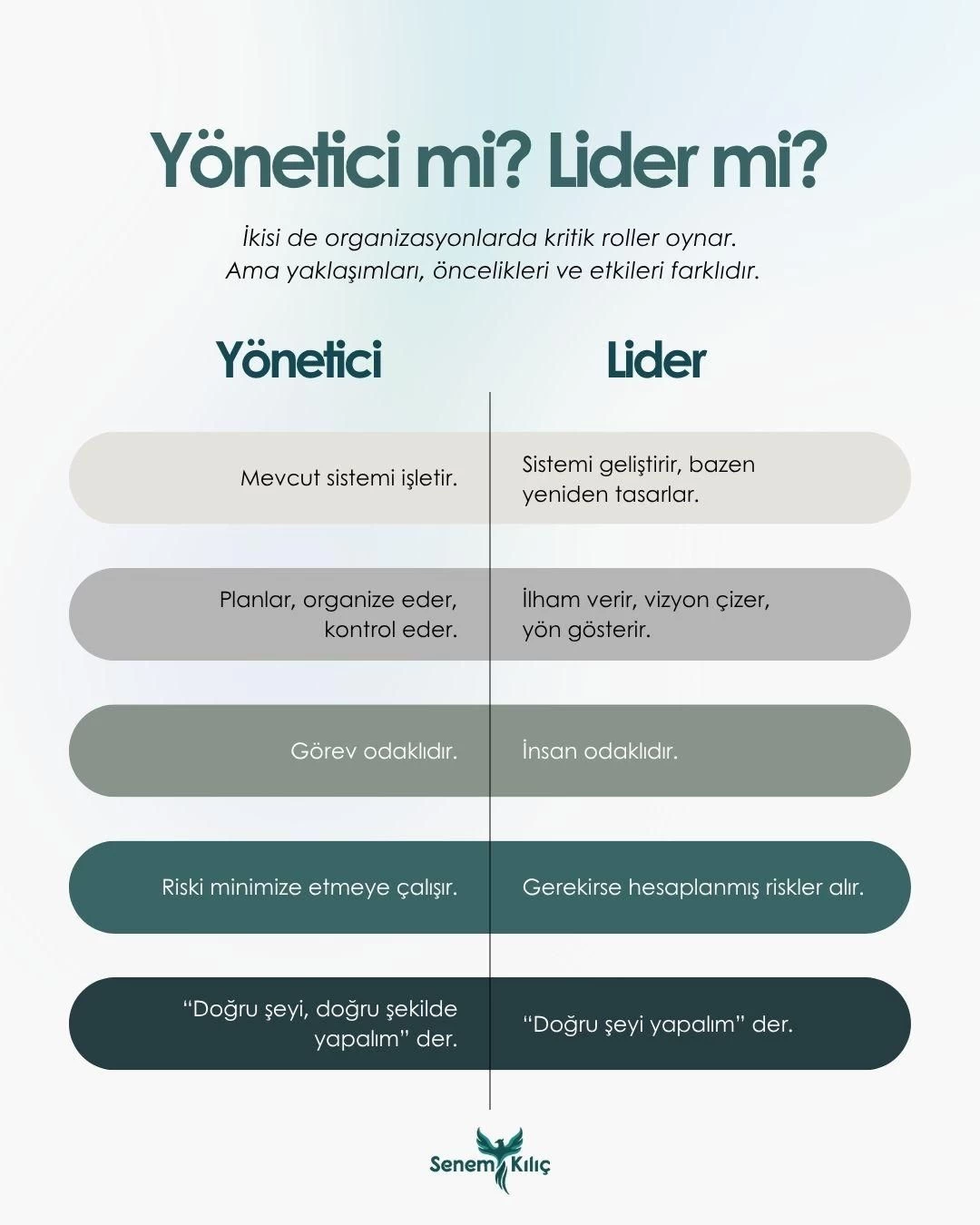
I prepared this post especially for young friends who have recently become managers, hoping it will offer different insights for everyone.
Topic: The Manager–Leader–Manager transition framework
In the image I shared, you can see the distinctions between the “roles” of a manager and a leader. This approach is clearly defined in the sub-disciplines of management science.
Summary of the image: While a manager preserves the system and maintains order, a leader develops the system, inspires, and guides with vision.
I wanted to define, within a single framework, the inner journey of a person experiencing the intertwined shifts between these different roles. This way, you can seek support in the areas you find challenging—because there is no such thing as a purely “good” or “bad” manager or leader. There is only someone who is open to growth.
Manager → Leader → Manager Transition Framework
1. Manager Starting Point
-
Focus: System, processes, performance metrics
-
Key Behaviors: Planning, control, risk minimization, operational efficiency
-
Strength: Maintaining order, ensuring stability
-
Mental Trap: Excessive control, suppressing creativity
2. Transition 1: Manager → Leader
Triggers:
-
Need for strategic change
-
Pressure for innovation
-
Decline in employee motivation
Mental Shift:
-
Moving from “How?” thinking to “Why?” thinking
-
Shifting from short-term to long-term focus
-
Moving from task-oriented to people-oriented thinking
Critical Skills:
-
Inspiring and creating vision
-
Taking calculated risks
-
Delegation and building trust
3. Leader Central Point
-
Focus: Vision, people, culture
-
Key Behaviors: Inspiring, setting direction, building culture
-
Strength: Driving change, fostering commitment
-
Mental Trap: Excessive visionarism, disconnect from daily operations
4. Transition 2: Leader → Manager
Triggers:
-
Crises and emergencies
-
Operational breakdowns
-
Decline in performance
Mental Shift:
-
Moving from “Why?” thinking to “How and When?” thinking
-
From abstract vision to concrete action
-
From flexible strategy to strict planning
Critical Skills:
-
Making quick decisions
-
Managing details
-
Minimizing risks
5. Mastery on the Framework – “Situational Leader–Manager”
Main Goal: Being able to switch between the two roles according to the situation
Balanced Profile:
-
Acting as a manager during crises and as a leader during growth periods
-
Maintaining focus on both people and systems simultaneously
-
Having the awareness to do both “the right thing” and “do it the right way”
This framework shows that leadership is not an alternative to management, but its complement. The most effective professional is the one who can smoothly transition between the two roles according to the situation.
With awareness…